

The Breach Between Belief and Behavior
Every human being who has ever walked the face of the earth, except for the one man Jesus Christ, has at one point or another known the right thing but failed to do it.
Whether as a child knowing it is kind to share toys with a brother or sister, or that it’s healthy to have a balanced diet and consistent workout routine, or knowing that sin you keep doing is wrong, or knowing it is right to give food and water to someone begging in the street; we have all kept the toy to ourselves, couch potato’d instead of hitting the gym, given in to temptation…again, and indifferently passed by the one in need in our margin-less schedules.
Deep inside we might have the right belief (or rather, knowledge of a Christian belief), and even the right affection, but there seems to be a gaping chasm at times between those and the right behavior—between our brain, our heart, and our body. This is not a modern problem but the human condition; however, I fear that gap is widening in the Technological Age.
George Barna, Director of Research at the Cultural Research Center at Arizona Christian University, has observed several alarming developments in American Christianity over the last five years. In 2021, roughly two-thirds of American adults self-identified as Christians, yet only 6% of the American population, labeled “Integrated Disciples,” demonstrated a consistent understanding and application of biblical principles. By February 2025, it was reported that this category of Integrated Disciples, had declined to claim “only a 4% share of the nation’s worldview pie.” [1]
Although I do not live and die by statistics, I have personally witnessed the disparity between the majority of self-identified, nominal Christians and the small percentage who truly embody and practice the teachings of Jesus… In fact, I am so certain of these statistics, I need look no further than the mirror to find the evidence.
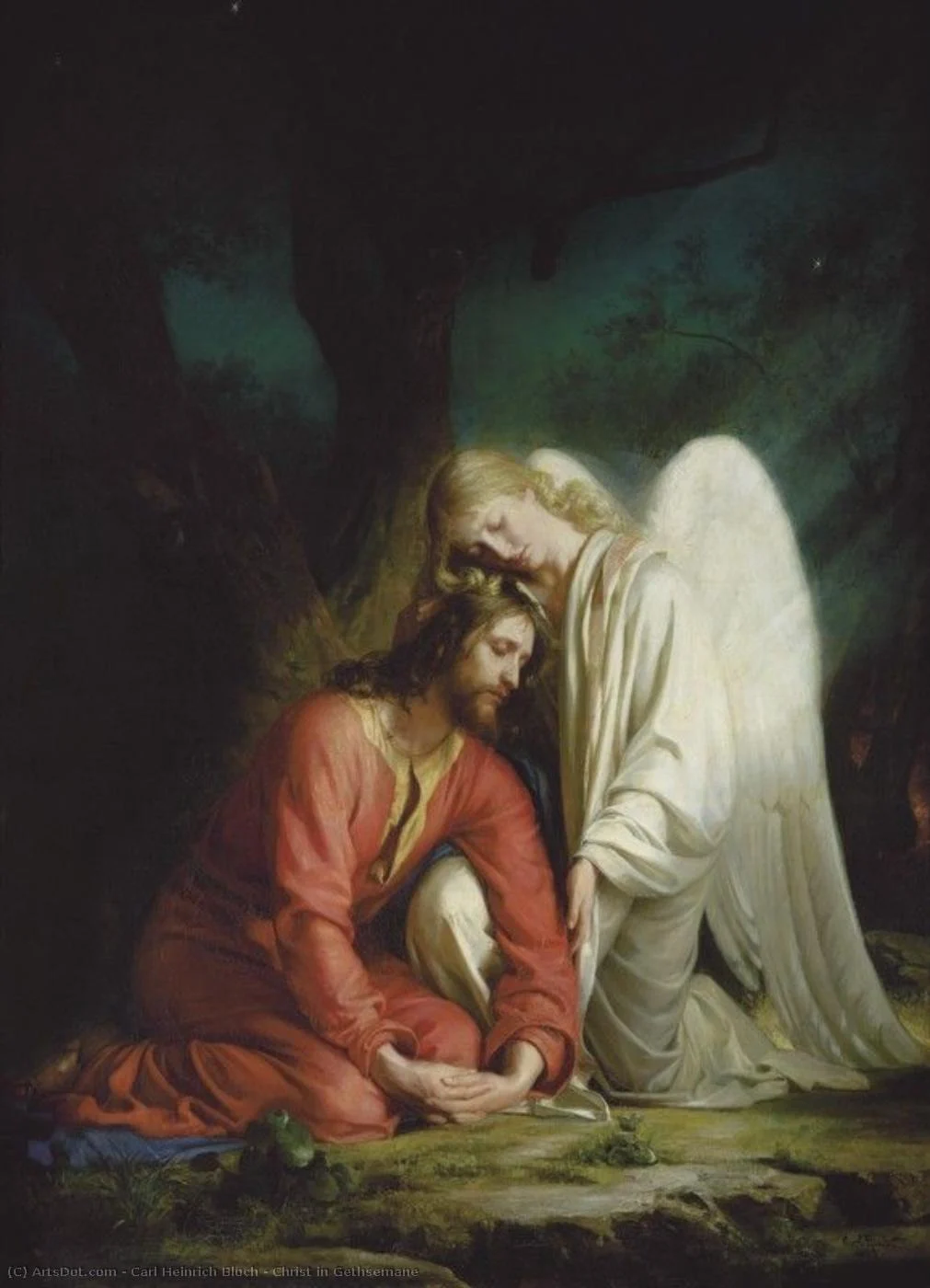
I dare not pretend that a brief little blog like this will solve all our problems, repairing the breach between our heads and our habits; but what I can offer is the insight Jesus gives me as He walks me through Gethsemane again and again. I’d like to invite you on that walk too:
“Then Jesus went with them to a place called Gethsemane, and he said to his disciples, “Sit here, while I go over there and pray.” And taking with him Peter and the two sons of Zebedee, he began to be sorrowful and troubled. Then he said to them, “My soul is very sorrowful, even to death; remain here, and watch with me.” And going a little farther he fell on his face and prayed, saying, “My Father, if it be possible, let this cup pass from me; nevertheless, not as I will, but as you will.”
And he came to the disciples and found them sleeping. And he said to Peter, “So, could you not watch with me one hour? Watch and pray that you may not enter into temptation. The spirit indeed is willing, but the flesh is weak.” Again, for the second time, he went away and prayed, “My Father, if this cannot pass unless I drink it, your will be done.” And he came and found them sleeping, for their eyes were heavy. So, leaving them again, he went away and prayed for the third time, saying the same words again. Then he came to the disciples and said to them, “Sleep and take your rest later on. See, the hour is at hand, and the Son of Man is betrayed into the hands of sinners. Rise, let us be going; my betrayer is at hand.” (Matthew 26:36-46 ESV)
I love reading not only what Jesus says, but what He does. Knowing He would soon be betrayed and crucified, He went to Gethsemane in the middle of the night, a quiet spot at the foot of the mount of Olives He frequented for fellowship with His disciples (John 18:2). He fell on his face and prayed… three times. He encouraged His friends to do the same, but from Luke’s perspective, they were sleeping from sorrow (Luke 22:45).
And I don’t blame them! Jesus had been predicting His death repeatedly, such confusing and terrible news from the most amazing person they had ever known. They were emotionally spent, and likely physically exhausted.
Besides all that, have you ever tried praying through the whole night? I’d be a goner at 1 AM.
The Flesh: Unaided Human Effort
Peter had the right belief and a willing spirit. He believed that he would never fall away, having pledged to die with Jesus (Matthew 26:35). He had the right emotion (sorrow). But when the time came for action, he denied Jesus three times. He didn’t exhibit wrong behavior so much as normal human behavior. He chose self-preservation over self-sacrifice (agape).
“Watch and pray, for the spirit is willing but the flesh (sarx) is weak.”
The Greek word sarx does not just mean “body” or “physical flesh;” it refers also to unaided human effort. [2] It is our natural humanness that, when operating independent of God, instinctually defaults to self preservation (sleep and safety). It is not that the physical flesh is the enemy; God wired our nervous systems to survive at all costs! It is that the body, without prayer, lacks the power (grace) to go where the Spirit wants to go… to the cross.
When you read Jesus’s prayers, behold His humanness! Look at the war fought in prayer “Let this cup pass from me,” “if this cannot pass unless I drink it…” Look to Luke’s account in which His agony was so great, He sweat blood! (Luke 22:44) “Not my will but yours be done” isn’t just a prayer template; this is Jesus wrestling to overcome His God-given survival instincts to willingly go to the cross. He overcame the natural urge to save Himself so He could save the world. How great the irony of the mocking voices: “He saved others; but he cannot save himself.” (Matthew 27:42) Billy Graham adds: “And in a terrible sense, they were right. He could not save himself and save you too.” [3]
Through much prayer and time spent with His Father, Jesus became ready to give His life away for the salvation of the world. However, the disciples, who could not will themselves to pray, fled the scene just as the Lord predicted, for they were acting in their natural, soulful self preservation.
As we walk with Jesus through Gethsemane again, He teaches us that through prayer, the Spirit of God begins to override our natural bent toward self-preservation and self-centeredness and begins aligns our will with His will: “Not my will but yours be done.”
Through prayer, the Spirit of God begins to empower us to deny ourselves, pick up our cross, and follow Him, even to the death. We might have the right thinking and even the right emotion, but when the time comes for the courageous right action, without prayer, we tend to fall asleep or fall into self preservation.
In other words, persistent prayer helps bridge the gap between right belief and right behavior. By our own unaided human effort, we cannot follow Jesus where He wants to take us because where He wants to take us goes completely against our natural human nature.
You might be asking, like Peter asked Jesus, “Lord, where are you going?” Lord, where are you taking me? Jesus answers, “Where I am going you cannot follow me now, but you will follow afterward.” (John 13:36).
I believe Jesus was pointing the way to the Cross. And Peter did, in fact, follow Him there; church tradition tells us he was eventually crucified upside down. [4] But the promise we have in Christ is that the Cross is not a dead end. It is the doorway to Resurrection and Eternal Life.
By our own unaided human effort, we won’t… we can’t follow him there, but through prayer, the Holy Spirit intercedes and transforms us by His power (grace) to move us into His agape and will.
Prayer is where we learn to “love the Lord your God with all your heart, soul, mind, and strength” and to “love your neighbor as yourself” (Mark 12:30-31). It is where we begin to lose our life for His sake that we might truly find it (Matthew 16:25). Here, we bridge the gap between belief and behavior, becoming Integrated Disciples in mind, heart, and soul. Just as He invited His friends to watch and pray then, Jesus is still inviting us into His Gethsemane today.
Have you felt the battle to pray lately? I am not talking about reading your Bible or listening to a podcast sermon; I am talking about getting on your knees or falling on your face before the Lord, speaking to and listening for Him.
If the struggle is real, you are not alone, my friend. The enemy spends monumental energy keeping the child of God from prayer, hoping to confine us to our natural limitations and cut off the grace found in intimacy with the Father.
Just as Jesus left the majority at the gate but called Peter, James, and John deeper into the garden, I pray He gives you the courage to leave the crowd behind and get on your knees today. May He take you from the 66% to the 4%… from the natural to the supernatural.
In Jesus’s name, Amen.
If you need someone to pray with, I would love to join you in Gethsemane. Please feel free to reach me anytime on the Contact page or the Live Prayer Chat button in the right corner of your screen.
Footnotes:
[1] George Barna, “American Worldview Inventory 2021 Release #6: What Does It Mean When People Say They Are ‘Christian’?,” American Worldview Inventory 2021 (Glendale, AZ: Cultural Research Center at Arizona Christian University, August 31, 2021), https://www.arizonachristian.edu/wp-content/uploads/2021/08/CRC_AWVI2021_Release06_Digital_01_20210831.pdf; George Barna, “American Worldview Inventory 2025 – Report 1: Most Americans Believe in a Supreme Power, But Not the God of the Bible” (Glendale, AZ: Cultural Research Center at Arizona Christian University, February 18, 2025). 1, 10. https://www.arizonachristian.edu/wp-content/uploads/2025/02/CRC-Release-AWVI-1-Feb-18-2025-Final.pdf “The American Worldview Inventory is the first-ever national survey conducted in the United States measuring the incidence of both biblical and competing worldviews… The data reported in this report were collected via the first of those two waves, conducted in January 14-20, 2025, among a national, demographically-representative sample of 2,100 adults (age 18 or older). The survey contained 82 questions… that fall within eight categories of worldview application, measuring both beliefs and behavior.”
[2] “4561. sarx,” HELPS Word-studies, Bible Hub,
[3] Billy Graham, The Power of the Cross, https://www.youtube.com/watch?v=hAtWsWxzYto
[4] Eusebius, Church History 3.1.2, in Nicene and Post-Nicene Fathers, 2nd ser., vol. 1, ed. Philip Schaff and Henry Wace, trans. Arthur Cushman McGiffert (Buffalo, NY: Christian Literature Publishing Co., 1890), https://www.newadvent.org/fathers/250103.htm.


YES AND AMEN
The struggle is real brother! Great post Mitch, keep putting in that work for the kingdom sir!
Great message